A printed flag is the cheapest piece of distance-visible branding you can buy. From across a car park, an exhibition floor or a sports field, a flag pulls the eye and points at where your activity is happening. The trade-off is that there are eight or nine different flag formats, each with different strengths, and most people default to whichever one they've seen at the last event they attended.
This is a guide to the printed flag formats Branding Warehouse builds, what each one does best, and how to pick the right shape for the activation you're running.
Feather Flags: The Classic Choice
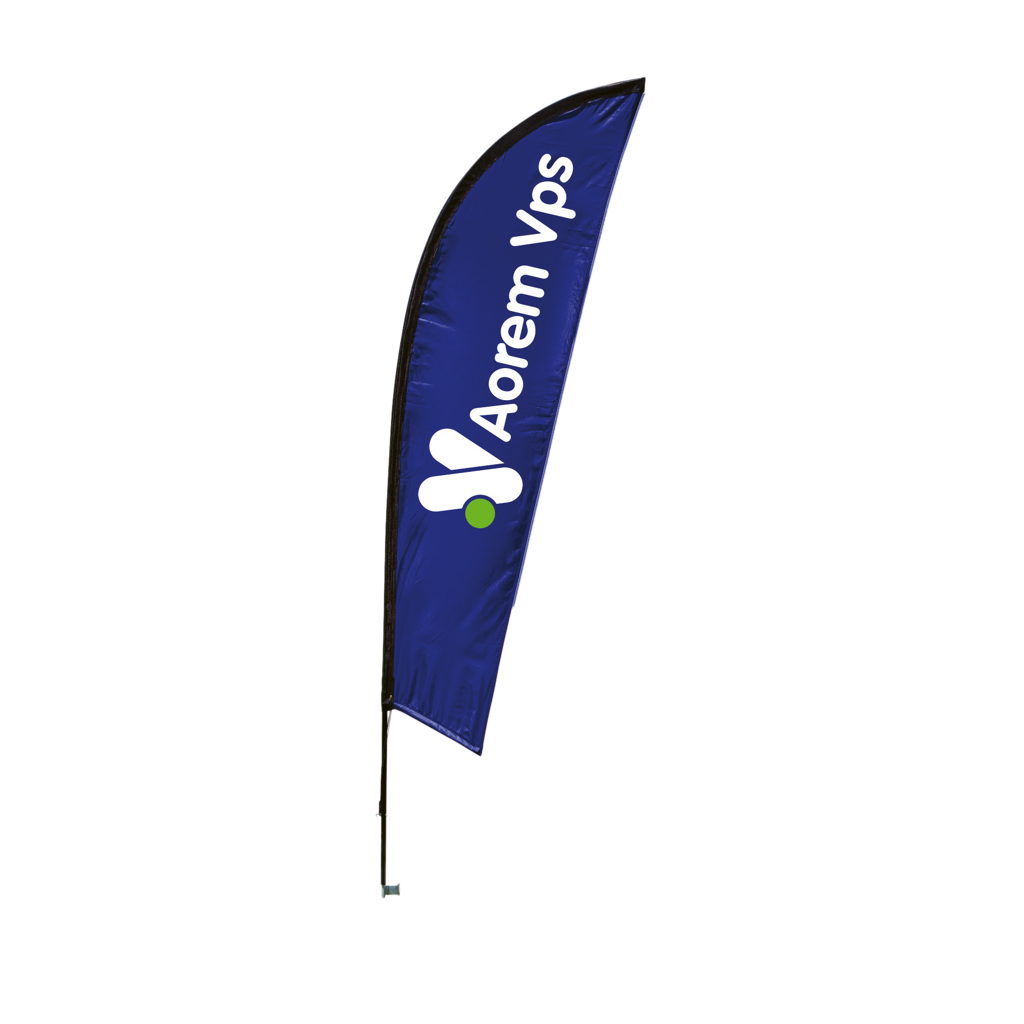
The feather flag, called a Finn at Branding Warehouse, is the format most people picture when they hear "event flag." Tall and narrow, tapering slightly toward the top, with a flexible pole that lets the printed surface flex in wind without fighting it.
Feather flags work because they're vertical and visible. At 3m or 4.5m of height, they break the eye line of anyone walking past at distance. They're cheap to produce, easy to set up (push the pole into a ground spike or a weighted base, slide on the printed sleeve), and they pack down into a single carry bag. For a market stall, a sports event, a construction site or a car-park activation, a feather flag is usually the first piece of signage that goes up.
The Smart Finn is the same shape but with a pole-rotation mechanism that lets the flag spin freely with wind direction. In gusty conditions, this is the difference between a flag that flutters cleanly and one that wraps around the pole and reads as nothing. If your events are mostly outdoor and exposed, the Smart Finn is the upgrade worth paying for.
Sail Flags: When Distinct Shape Matters
A Sail flag has a curved top edge that arcs forward like the sail of a yacht. The shape is more recognisable than a straight feather, which matters at busy events where dozens of vendors are running similar-looking flags. A sail flag stands out as a sail, and your branding rides on top of that distinct shape.
Sail flags catch wind slightly more than feather flags because of the curve. That's a feature in low wind (the flag bows nicely and reads as 3D) and a problem in heavy wind (more force on the pole). Match the format to the typical wind exposure of your event venues.
Telescopic Flags: Adjustable Height
A Telescopic flag uses a sectional pole that extends in segments, like a fishing rod or a telescope. The pole adjusts from around 2m up to 4.5m, depending on what each venue allows.
This matters more than it sounds. Some venues cap signage height at 3m. Some festivals require 2.5m. Some indoor expos have ceiling restrictions that make a full-height flag impossible. With a telescopic, you adjust on-site instead of arriving at a venue and finding out your flag doesn't fit.
The Smart Telescopic combines the adjustable-height pole with a rotating mechanism, giving you both flex on height and clean reading in wind. For event teams that work multiple venue types, it's the most versatile flag in the BW range.
Cluster Flags: When You Need Volume
A Cluster is a single base unit holding three or four printed feather-style flags grouped together. Used for finish lines, gateways, sponsor zones, anywhere you need a wall of branding rather than a single point.
Clusters are particularly effective for sponsor activations where multiple brands need to share visibility, or for large-scale brand events where one flag in front of a 1000-person audience reads thin and four flags as a cluster fills the visual space.
Curvehead Flags: Built for Wind
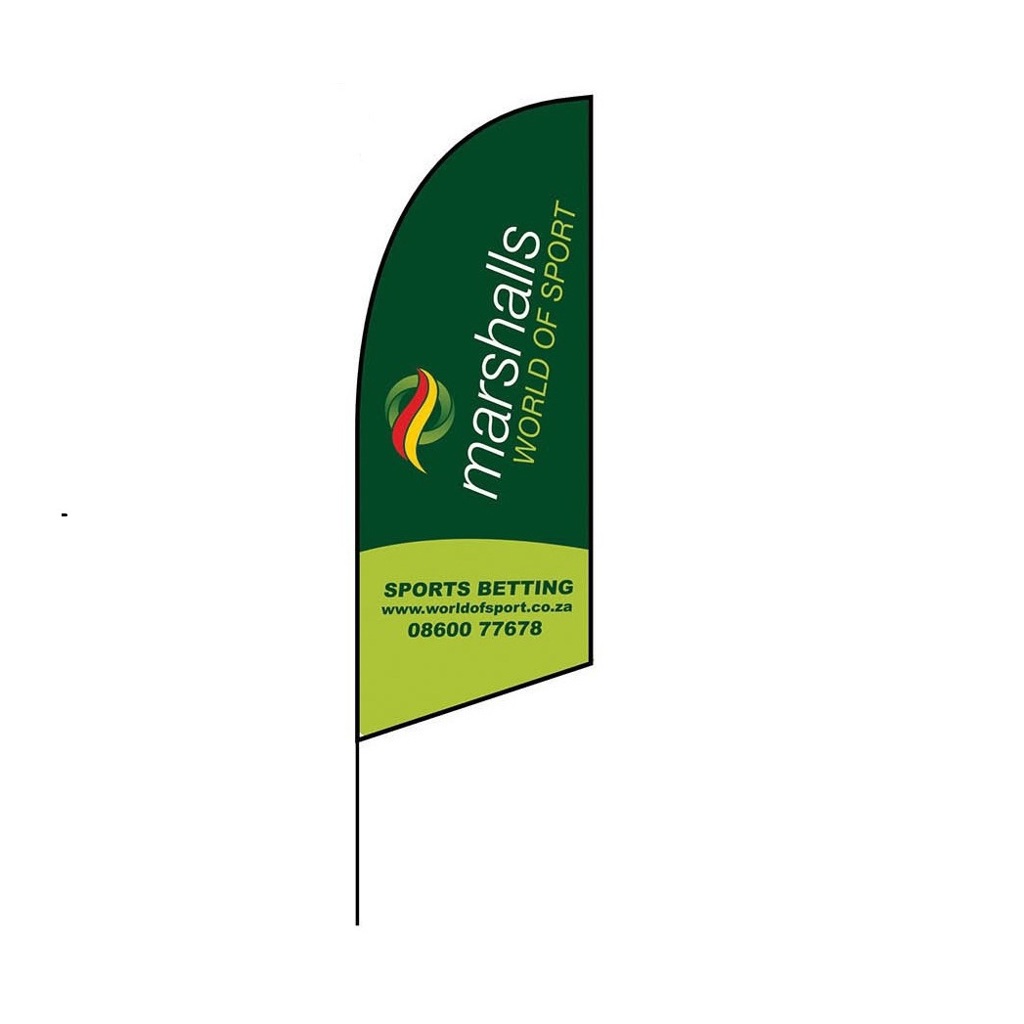
A Curvehead has a curved upper section, where the top of the flag bends in an arc. The curve provides structural rigidity in wind that a straight feather doesn't have, and the distinct head shape makes the flag recognisable from a distance.
If your events run on exposed coastal sites, in open fields, or anywhere with sustained breeze above 15 mph, a Curvehead holds its shape better than a standard Finn. It's also visually different enough to stand out at events where everyone else has a generic feather flag.
Backpack Flags: Mobile Branding
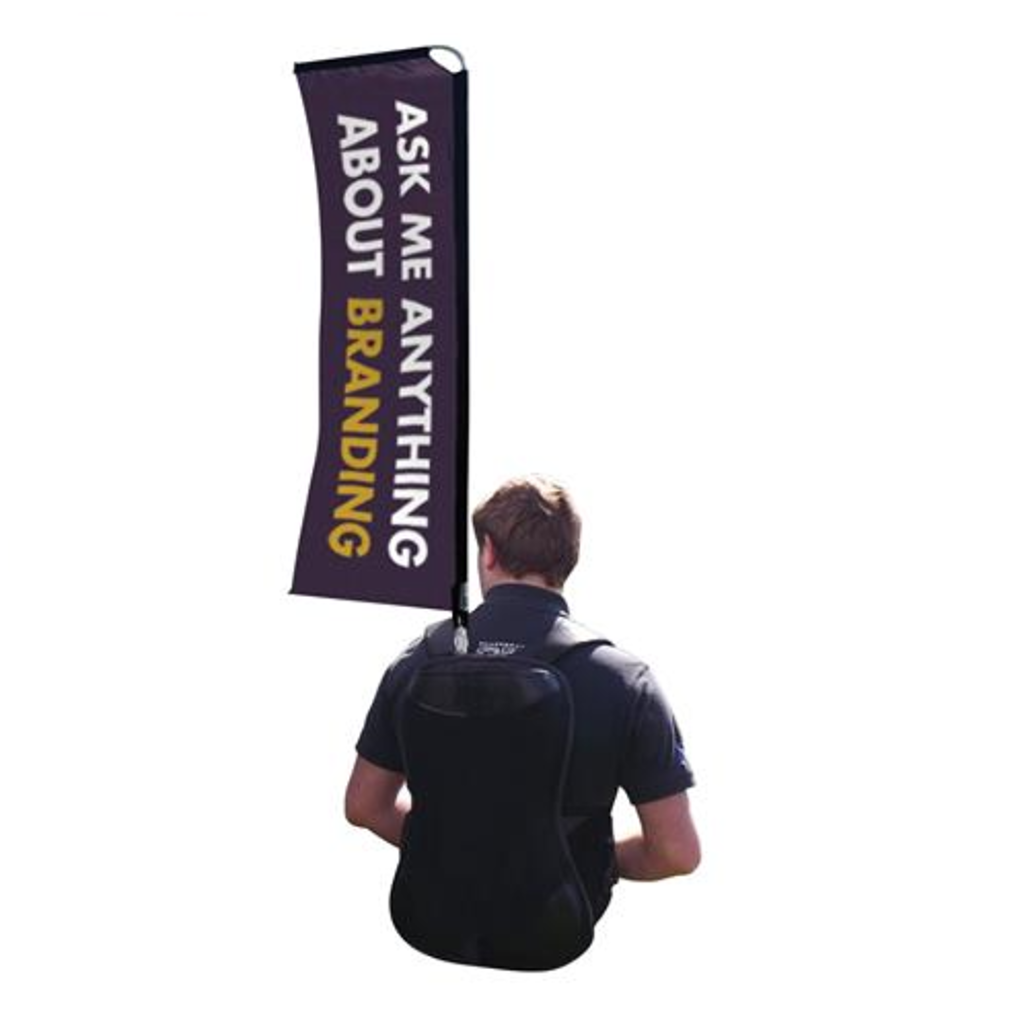
A Backpack Flag is a wearable harness that mounts a small flag on a flexible pole rising above the wearer's shoulders. Brand ambassadors put on the harness and walk through crowds at festivals, sports stadiums, shopping centres or street activations, and the flag tracks with them.
The use case is specific but powerful. When you can't put fixed signage somewhere (a busy festival walkway, the inside of a stadium, a city centre street), a backpack flag is signage that walks. Combine it with a printed t-shirt or vest on the wearer and you have a moving brand activation that engages people at street level.
Picking the Right Flag for Your Activation
Working through the decision tree:
Outdoor market or shopfront, low wind, single point of sale. A standard Finn does the job at the lowest cost. Pair with a Smart Finn if there's any wind concern.
Sports event, race or large outdoor activation. Cluster of feather flags at finish lines and sponsor zones. Add backpack flags for ambassadors moving through the crowd.
Sponsor activation at a festival. Sail flags for visual differentiation, paired with a printed gazebo and a pop up backdrop for the stand itself. The flag pulls people from distance; the gazebo and backdrop are where they engage.
Indoor expo or trade show. Telescopic flag inside the booth (height adjusts to the venue), or skip flags entirely and rely on pull up banners and a pop up backdrop. At indoor distances, banners read more cleanly than flags.
Coastal or high-wind venue. Curvehead or Smart Finn. Avoid sail flags in sustained gusts above 25 mph.
Roaming or street activation. Backpack flags. Mobile branding that goes where the crowd is.
Print, Pole and Base Considerations
Three things to check before you order:
Single-sided vs double-sided print. Single-sided prints the design on one side of the fabric and shows it through reversed on the other (like a translucent t-shirt graphic). Double-sided prints both sides separately with a light-blocking layer between, so each side shows the correct design. Double-sided costs more, and for most flags it's not necessary because flags rotate in wind and people see them from one side at a time. Pay for double-sided when the flag will be in a fixed position (a bracketed shopfront flag, a stage-side flag) where viewers see it from a consistent direction.
Base type. Ground spike for grass and soft ground (cheapest, fastest setup). Cross-base for hard surfaces (paving, parking lots, indoor floors). Water-fill base for venues where you can't peg or use weights but need a portable solution that fills with water on-site.
Pole material. Fibreglass for general use (light, flexible, packs short). Aluminium for higher-wind environments where you want more rigidity. The default for most BW flags is fibreglass.
A printed flag, looked after, lasts years. The pole holds up indefinitely and the print typically stays sharp for 2-3 years of regular outdoor use. Pack flags away dry, store them out of UV when not in use, and they'll outlast most other event signage you own.
Branding Warehouse manufactures all flag formats in the UK. Browse the full flag range for sizes and formats, or contact us for advice on the right format for your event.